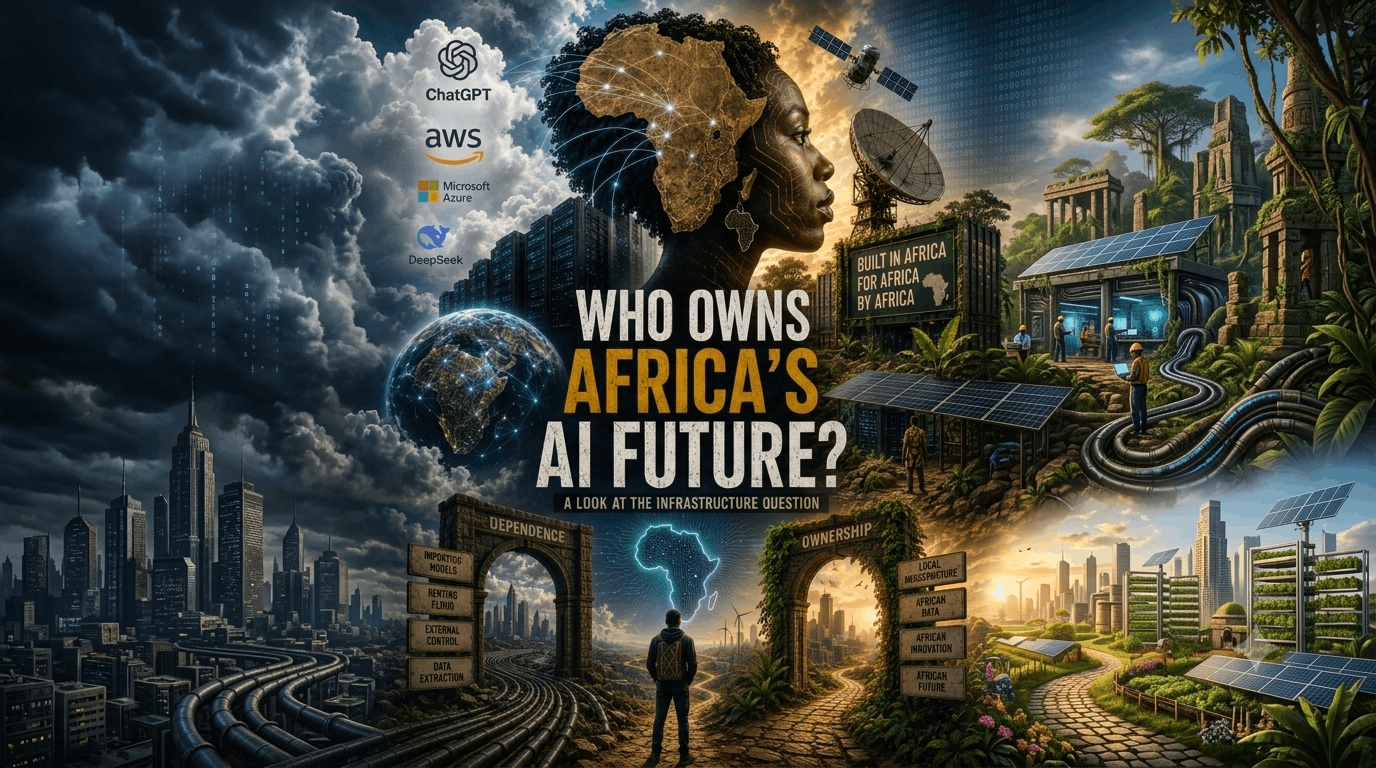
There’s a question about artificial intelligence Africa isn’t asking often enough.
Who owns the infrastructure?
We’re becoming comfortable using AI: building businesses around it, integrating it into our workflows, creating products for African markets. But underneath most of these applications sits infrastructure Africa doesn’t own. The models are often built elsewhere. The computing happens elsewhere. The chips are designed and manufactured almost entirely outside the continent. Even when an African company builds a genuinely excellent product, the foundation beneath it may still answer to someone else.
That’s worth pausing on. Not because using foreign technology is inherently bad. Africa has always adopted technologies built elsewhere. The issue is what happens when adoption becomes the only mode of participation.
We’ve Seen This Movie Before
The internet economy taught this lesson once already. Search consolidated around Google, Bing, Yandex. E-commerce around Amazon. Social communication around Meta, X, and others. African companies built real businesses on top of these platforms, and Africans became some of the most active users of digital platforms in the world. But very little of the underlying infrastructure was ever African.
There’s a real difference between building on infrastructure and owning it. You can build something brilliant on someone else’s platform and still not control its pricing, its rules, its availability, or its direction.
The AI Stack Is Bigger Than the Chatbot
Most conversations about AI stop at the interface: ChatGPT, Claude, Gemini, DeepSeek, Copilot. But underneath sits an enormous stack: the chips that do the computing, the data centers that house them, the electricity that powers them, and the models and datasets that run on top. The real contest isn’t over who has the best chatbot. It’s over who controls the systems that make intelligence available at scale, and here, Africa’s position is genuinely uncomfortable.
That’s not to say nothing is happening. Lelapa AI in Johannesburg has built InkubaLM, a compact multilingual model covering Swahili, Yoruba, isiXhosa, Hausa, and isiZulu, languages the major global models have historically served poorly. Africa Compute Fund is building a network of locally owned computing clusters, starting in Nairobi and expanding into Nigeria and South Africa. This is a story about scale and ownership, not about Africans doing nothing.
Building Applications Is Not the Same as Building Infrastructure
Picture an African entrepreneur building the best AI powered healthcare platform in Nigeria. If it runs on a foreign model, foreign cloud, and foreign computing power, who owns the application? The entrepreneur. Who owns the infrastructure underneath it? Someone else. That doesn’t make the company insignificant. It means its independence is limited.
Thousands of brilliant African AI applications can exist, and the continent can still be structurally dependent, if the layer underneath all of them sits elsewhere.
Why Ownership Matters
He who pays the piper dictates the tune. Owning infrastructure means having power over access, pricing, availability, and direction. That’s not an accusation that providers will necessarily abuse that power. It’s simply what dependence means: you don’t have the final say.
That matters more as AI moves deeper into education, healthcare, finance, public administration, and media, not just processing information but shaping access to it, influencing which languages get investment, and becoming embedded in the institutions through which societies run.
Ownership Is Bigger Than Data
Much of Africa’s digital ownership conversation has focused on data. AI expands the list of questions: who owns the computing power, the chips, the data centers, the networks? Who sets the prices, and who decides which tools can even be used? These are no longer just technical questions. They’re economic and political ones.
Africa Doesn’t Necessarily Need Its Own ChatGPT
Building a top-tier AI model from scratch is enormously expensive, so it likely isn’t realistic for every African country to try. The sharper question is which parts of the stack Africa needs to own, and which it can access from others on better terms.
Some of this is already being tested. Kenya and Nigeria are each building their own cloud platforms so that African data and AI workloads can stay closer to home. South African billionaire Strive Masiyiwa’s company, Cassava Technologies, has launched an AI computing facility in South Africa with chipmaker Nvidia, with plans to add roughly 3,000 more chips there and expand into four other countries. In 2025, African leaders signed a continent-wide AI declaration in Kigali, backed by 49 countries, that included a $60 billion fund and a pledge to secure 12,000 AI chips. It’s an ambitious plan, and also a candid admission: near-term progress still runs through hardware built abroad. The honest way to read that fund is less as full independence and more as buying leverage and time on machines Africa actually controls.
This May Be Too Big for Any Single Country
Fragmentation is one of Africa’s recurring problems; fifty four countries individually rebuilding modern AI infrastructure would be inefficient, in places impossible. But fifty four countries representing over a billion people is a different proposition entirely.
The African Union’s Continental AI Strategy, adopted in 2024, sets out five priorities: benefiting from AI, building local skills, managing risk, attracting investment, and cooperating across borders. Regional groups are following suit. East African Community countries adopted their own AI agreement in 2026, committing to a shared fund and to building systems trained on local languages and data. The conversation has started. The open question is whether it moves at the scale the problem needs.
The Infrastructure Beneath the Infrastructure
AI needs electricity, buildings, internet cables, cooling systems, specialized chips, and the money and engineers to run all of it. Steady, reliable power is one of the most commonly cited obstacles to Africa’s AI buildout. Solving this isn’t just a technology problem. It’s a human, financial, and institutional one.
The Opportunity Is Still Open
The AI infrastructure race is still being built; the rules are still forming. Africa can be a consumer, an application builder, a data provider, or an owner of meaningful pieces of the system itself. It doesn’t have to be all or nothing. But the continent probably needs to own enough of the stack that its future doesn’t depend entirely on the pricing, priorities, and goodwill of others.
The real question isn’t whether Africans are using AI. Clearly they are. It’s whether, ten years from now, the infrastructure underneath African healthcare, finance, education, and governance will be infrastructure Africans helped build and own, or another foundation built somewhere else.